
Pressure Literacy 101
Learn to read behavior more carefully when workplace conditions get harder.
Pressure Literacy 101 introduces a shared way to examine changes in communication, decision-making, participation, and independence before assigning meaning or deciding how to respond.
Introductory organizational course for workplace cohorts
See What Participants Learn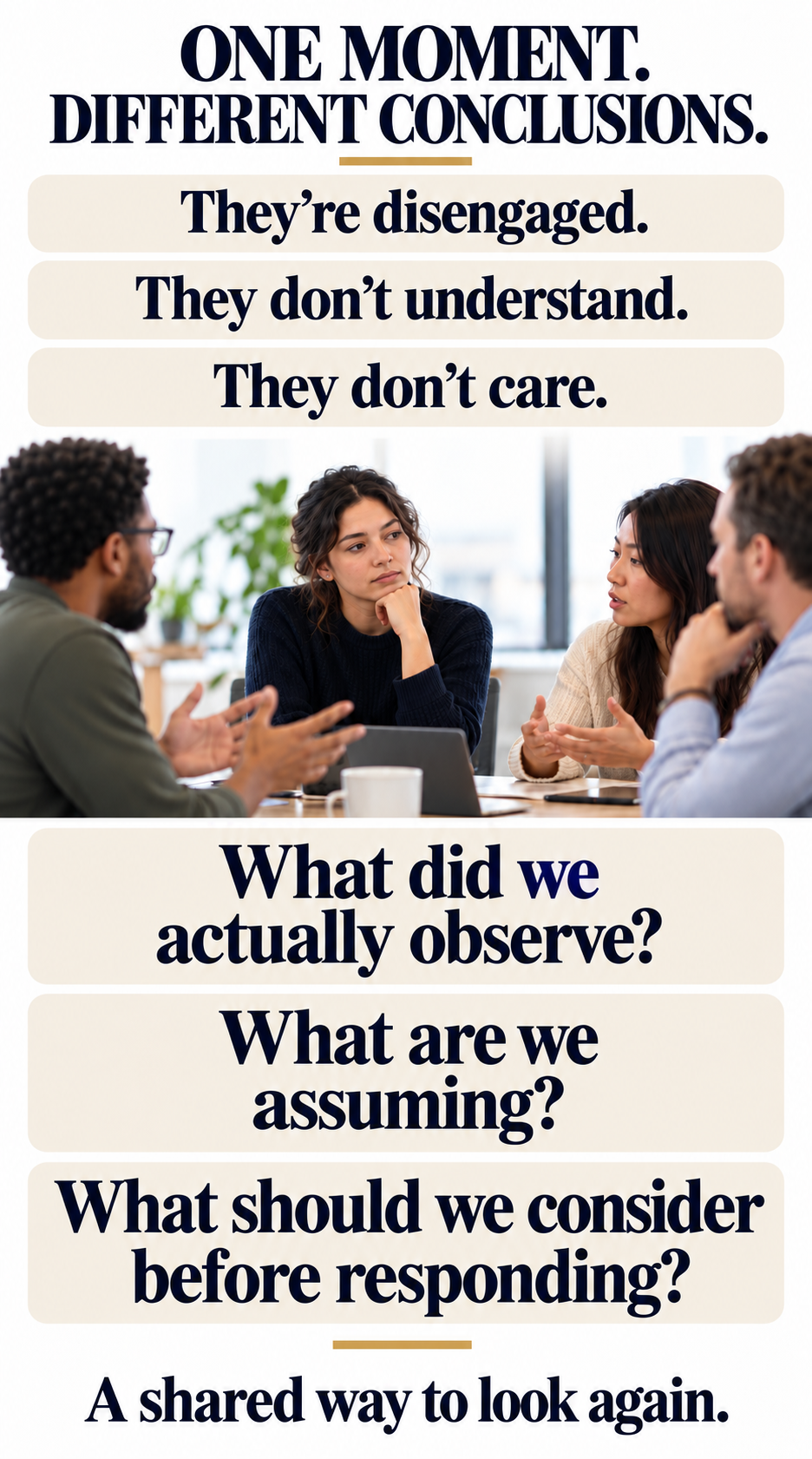
The same behavior can produce very different conclusions.
An employee becomes quieter in meetings.
One manager sees disengagement.
Another sees uncertainty.
Someone else assumes the employee no longer cares.
The observable behavior may be the same. The meaning assigned to it can change depending on who is interpreting the moment.
Pressure Literacy 101 gives participants shared language for slowing that process down.
- Observation
- The employee has contributed less in the last three meetings.
- Interpretation
- They are disengaged.
Those are not the same statement.
Learning to separate them creates a more disciplined starting point for questions, conversations, and decisions.
What do participants learn in Pressure Literacy 101?
Pressure Literacy 101 introduces a structured way to examine behavioral change without jumping from what happened to what it must mean.
OBSERVE
Notice what changed.
Focus first on what can actually be seen, heard, or described.
DESCRIBE
Put the behavior into specific language.
Move from broad labels to a clearer description of what occurred.
CONSIDER PRESSURE
Ask whether demanding conditions could be influencing what is happening.
Pressure enters the consideration. It does not automatically become the explanation.
CHECK ASSUMPTIONS
Separate what is known from what has been inferred about attitude, motivation, competence, personality, or intent.
RESPOND INTENTIONALLY
Use what has actually been observed to inform the next question, conversation, or response.
Behavior is visible. Meaning requires interpretation.
Learning the process also means learning its boundaries.
Pressure Literacy is useful because it does not require a quick explanation for every change in behavior.
Capability and access to capability are not always the same thing.
Someone may know how to communicate, make decisions, collaborate, adapt, or work independently and still access those capabilities differently when conditions become harder.
Change is information, not diagnosis.
A change in behavior can tell us that something is different.
It does not automatically tell us why.
Observation comes before interpretation.
What happened and what we believe it means are two different things.
Pressure is considered, not assumed.
Pressure may be relevant.
So may workload, role changes, conflict, uncertainty, new expectations, or other conditions.
The course does not teach participants to make pressure the answer.
Accountability remains.
Pressure Literacy can improve the starting point of interpretation.
It does not eliminate expectations, standards, responsibility, feedback, or consequences.
Where can Pressure Literacy 101 fit inside an organization?
The course is designed for workplace cohorts and can complement development already happening inside an organization.
When people are learning to lead
Managers, supervisors, emerging leaders, and frontline leaders regularly make judgments about communication, participation, decision-making, independence, and performance.
Pressure Literacy gives them another lens for examining behavioral change before deciding what that change means.
When people are preparing for workplace demands
Workforce-development participants, apprentices, technical learners, new employees, and early-career cohorts may know what effective workplace behavior looks like in training.
The harder question is what happens when expectations, correction, deadlines, uncertainty, scrutiny, or consequences enter the environment.
Pressure Literacy helps make that difference discussable.
When people are working through change
- New responsibilities.
- New technology.
- New leadership.
- New processes.
- Growth.
- Restructuring.
Changing work can produce changing behavior for many reasons.
Pressure Literacy gives teams a structured way to examine what changed before settling too quickly on why.
The course is designed to sit alongside existing leadership, workforce-readiness, technical, and organizational-development work rather than replace it.
A structured introduction designed for workplace cohorts.
ONE HALF-DAY SESSION
A concentrated learning experience completed in one block.
TWO 90-MINUTE SESSIONS
The course is divided across two sessions.
THREE 60-MINUTE SESSIONS
The learning is distributed across three shorter sessions.
- No prior Pressure Literacy knowledge is required.
- Designed for organizational cohorts.
- Participants receive a Certificate of Completion.
The Certificate of Completion recognizes participation in the educational course.
It is not professional certification.
What kind of course is Pressure Literacy 101?
Pressure Literacy 101 is workplace education.
It teaches participants a way to examine behavior, context, interpretation, and response more carefully.
It is not therapy. It is not mental-health treatment. It is not personality typing. It is not a clinical assessment. It is not professional certification.
And it does not qualify participants to diagnose coworkers or determine what another person is thinking, feeling, or intending.
Pressure Literacy 101 also does not teach participants to use The Pressure Institute's proprietary measurement systems.
The course stays focused on learning the lens.
One body of work. Different ways to engage with it.
Bring Pressure Literacy 101 into your organization.
If your organization is developing managers, preparing people for workplace demands, supporting a cohort, or working through changing conditions, the next step is a conversation about where Pressure Literacy 101 could fit.
We can discuss the audience, development context, preferred session structure, and scheduling needs.
Tell us about the people you are preparing and the setting in which they will use the learning.